

Wasp Season Has Begun: What to Do Now
You usually notice wasps before you see the nest. A few hovering near the roofline, a steady stream flying in and out of a gap, or sudden activity around the deck is often the first sign that wasp season has begun. If you catch it early, the problem is easier, safer, and less expensive to deal with.
In Ontario, wasps become much more active as temperatures rise. What starts as a small nest in spring can turn into a serious issue by mid to late summer. For homeowners, property managers, and business owners, that matters because wasps do not just create a nuisance. They can make entryways unsafe, put kids and pets at risk, and create a real liability around tenants, customers, and staff.
Wasp season has begun – why early action matters
A lot of people wait too long because they hope the problem will stay small. That is rarely how it goes. A queen starts building early, and once worker wasps take over, nest activity ramps up fast. By the time you are seeing frequent wasp traffic in one area, the nest may already be well established.
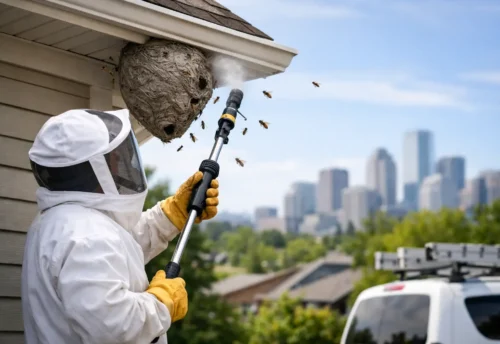
Early treatment matters for a simple reason: smaller nests are easier to remove and usually involve less risk. Once a colony grows, wasps become more defensive around the nest, especially if it is disturbed by vibration, lawn equipment, kids playing nearby, or someone trying a do-it-yourself spray from too close.
This is also the time of year when people spend more time outside. Patios, sheds, playground areas, storefronts, garbage zones, and roof edges all become problem spots. If wasps are active near a front entrance or outdoor seating area, the issue quickly becomes urgent.
Where wasps usually build nests
Not every nest is out in the open. Some are easy to spot, but many are tucked into protected areas where activity is the only clue. In residential and commercial properties, common nesting locations include roof soffits, attic vents, wall voids, deck undersides, sheds, garages, fence posts, and around window or door frames.
Ground nests are another concern. Some wasp species build in old rodent burrows or hollow areas in the lawn. These are especially dangerous because people often do not know the nest is there until they mow over it or step too close.
In places like Georgina, Keswick, Sutton, and nearby communities where homes often back onto green space, water, or larger yards, wasp pressure can be higher simply because there are more sheltered nesting areas. Rural and semi-rural properties also tend to have more outbuildings, eaves, and hidden voids that give wasps a head start.
Signs you may already have a nest
One wasp flying by is not always a problem. Repeated traffic in the same spot is different. If you notice wasps entering a crack, hole, or vent over and over, there is a good chance a nest is active inside.
Another sign is increased activity around food, garbage, recycling, or sugary drinks. That does not always mean the nest is on your property, but it does mean nearby colonies are active and growing. If activity keeps increasing each week, it is worth checking the property more carefully.
You may also hear a faint buzzing inside a wall or ceiling near an active nest. This can happen when wasps build in enclosed spaces. In those cases, the nest is harder to access and do-it-yourself treatment often makes the situation worse by driving wasps into other parts of the structure.
The biggest mistakes people make
The most common mistake is trying to knock down a nest without treating it properly. A visible paper nest may look simple to remove, but if live wasps are still active, that approach can trigger a fast defensive response.
Another mistake is sealing the entry point too early. If wasps are entering through a gap in siding or soffit, some people try to caulk the hole shut right away. That can trap live wasps inside walls or force them to find another route into the building.
Store-bought sprays can help in very limited situations, but they are not a complete answer for every nest. Height, access, nest size, species, and location all matter. A small exposed nest under an eave is very different from an established colony inside a wall cavity or underground near a walkway. What works in one case can be unsafe in another.
How to reduce wasp activity around your property
You cannot control every wasp in the area, but you can make your property less attractive. Start with food and waste. Keep garbage bins closed tightly, rinse recycling, and clean up sugary spills quickly. Outdoor eating areas should be wiped down after use, especially during peak activity.
Next, look at access points. Gaps around soffits, vents, siding, and utility openings can all become nesting sites. Sealing these areas helps, but timing matters. If there is current activity, have the nest dealt with first and then complete exclusion work after the problem is inactive.
Yard maintenance helps too. Overgrown shrubs, cluttered sheds, and neglected corners create shelter. If you have a deck or detached garage, check underneath and around the trim regularly during spring and early summer. Catching a small nest early is always better than finding a large one when the area is already in heavy use.
When a wasp problem becomes urgent
A nest near a doorway, play area, driveway, or business entrance should be treated as urgent. The same goes for any nest in a wall, attic, or high-traffic outdoor space. If someone in the home or workplace has an allergy to stings, even a small nest deserves immediate attention.
Urgency also depends on behavior. Wasps that are consistently aggressive, swarming around one zone, or reacting to normal movement nearby are not something to monitor for another week. They are a safety issue now.
For commercial properties, delay can create customer complaints and staff concerns very quickly. For rental properties, a wasp issue can escalate into a tenant safety problem if not handled promptly. Speed matters, but so does doing the job correctly.
Why professional removal is often the safer choice
Wasp control is not just about killing visible insects. The real job is finding the nest, treating it effectively, and reducing the chance of repeat activity in the same area. That is where professional service makes a difference.
A trained technician can identify whether the nest is exposed, hidden, aerial, or underground and choose the right treatment for the location. That lowers the risk of provoking the colony or leaving part of the problem behind. It also helps protect kids, pets, and anyone using the area soon after treatment.
For many customers, discretion matters as much as speed. If wasps are affecting a business entrance or rental property, you want the issue handled quickly without unnecessary attention. That is why local fast-response service is often the best fit when the problem cannot wait.
What to expect after treatment
People often expect all wasp activity to stop instantly. Sometimes it does, but not always. Depending on the treatment and the nest location, you may still see some movement for a short period as returning wasps come into contact with the treated area.
What matters is whether activity drops off as expected and whether the nest is fully inactive before removal or sealing takes place. In hidden nest situations, follow-up may be needed, especially if the colony is deep inside a structural void.
After removal, prevention becomes the next step. Areas that supported one nest can attract another later in the season or the following year if the same conditions remain. A quick inspection of soffits, vents, sheds, decks, and garbage areas can go a long way.
Do not wait for a small nest to become a big problem
If you are seeing repeated wasp activity around your home or business, trust what you are seeing. A few wasps today can turn into a much larger nest sooner than most people expect. The safest move is to act early, especially if the nest is hidden, hard to reach, or close to people and pets.
For property owners in Georgina and surrounding areas, wasp issues are a seasonal problem, but they are not one you have to manage alone. Discount Pest Control helps handle active nests quickly, safely, and discreetly so you can get back to using your space without the stress of stings overhead or underfoot. If something feels off around your roofline, deck, shed, or entrance, it is worth dealing with now while the situation is still manageable.
Leave a Comment